
Cuba December 2025
Another project workshop brought the participants to the University of Granma in Bayamo, Cuba, at the beginning of December 2025.
Following an internal meeting of the project management at the start, researchers from Cuba, Ethiopia, Ecuador, and Germany presented their results on various focal points.

Biodiversity and innovative cultivation management
The focus was on strategies to increase the resilience of crops to environmental stress and the optimization of soil indicators in agroforestry systems.
- Carlos Amador (UDG, Cuba): Effect of QuitoMax application in tomato cultivation and potential uses in underutilized plant species.
- Irisneisy Paz (UDG, Cuba): Evaluation of morphometric, physiological, and biomass indicators in ecotypes of cashew.
- Hector Hernández (UCLV, Cuba): Influence of management on soil indicators determining the quality of underutilized plant species in agroecosystems.
- Orelvis Portal (UCLV, Cuba): Phosphorus-mobilizing bacteria as bioinoculants to promote plant growth.
Medicinal plants and biotechnological potentials
Another focus lay on the connection between traditional knowledge and modern science, particularly in the development of nutraceuticals from underutilized plant species.
- Silvia Llerena (IKIAM, Ecuador): From Kichwa tradition to biotechnological potential: Biological and phytochemical study of Fittonia albivenis, Carludovica palmata and Hypolepis parallelogramma.
- Karel Dieguez (IKIAM, Ecuador): Oenocarpus bataua as a model of an underutilized plant species for the development of nutraceuticals against diabetes.
- L. Lázaro E. Valdés (UDG, Cuba): Antioxidant activity of Morus alba.
- Maria Carvajal Mena (UDG, Cuba): Antidiabetic potential and phenolic composition of Roystonea regia roots.
- Elizabeth Pérez (UDG, Cuba): Histochemical characterization of endemic species of the Pico Bayamesa Park.
Materials research and resource management
In addition to biology, the technical use of plant residues and the ecological monitoring of water resources were also discussed.
- Elio Macias (UDG, Cuba): Extraction of nanocellulose from hulls of Canavalia ensiformis for the production of filaments for 3D printing.
- Rubén R. Estrada (UDG, Cuba): Assessment of water quality in the Bayamo river basin.

The workshop concluded with a practical day in the region's "Living Labs."
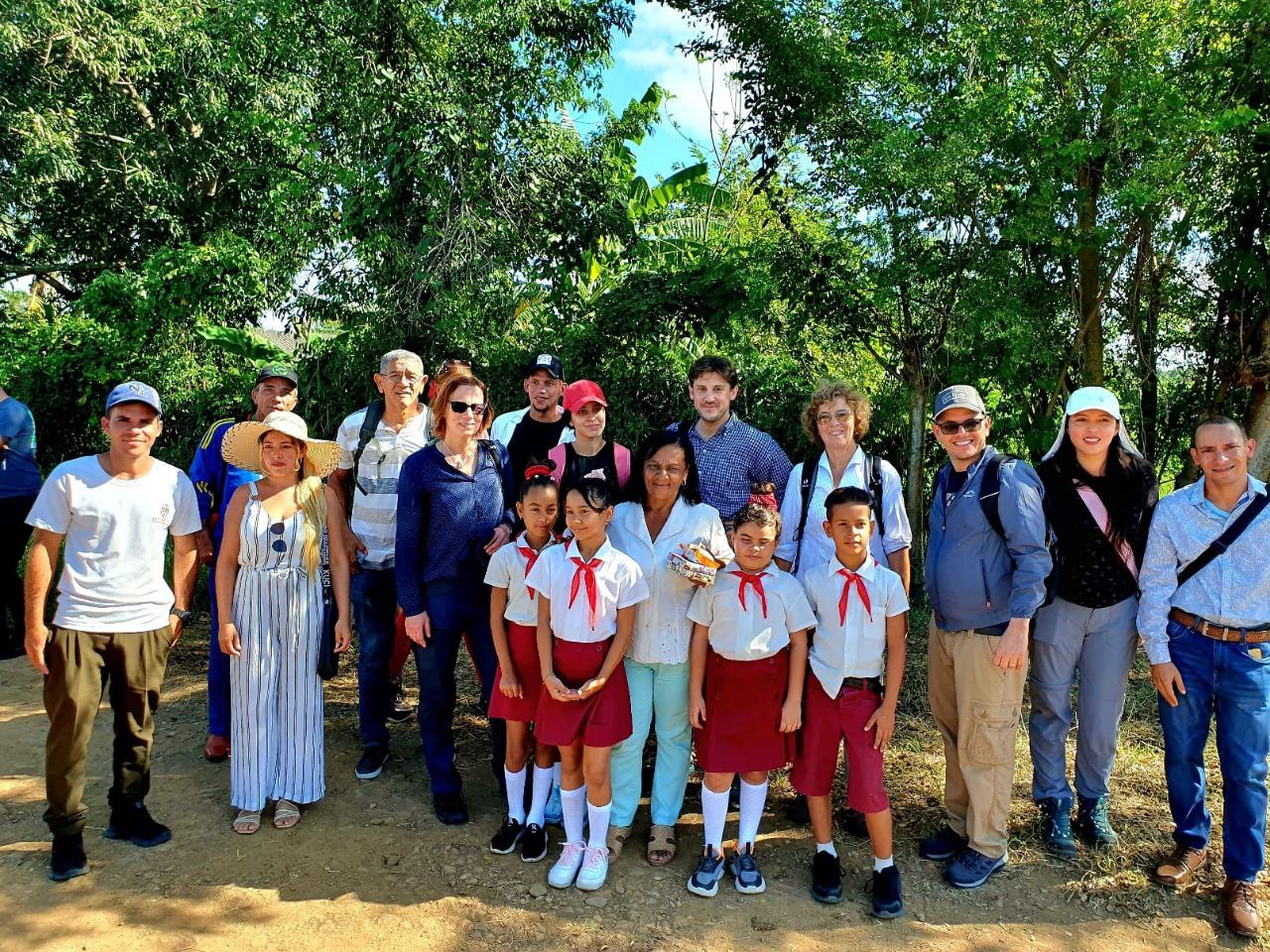
In the "La Victoria" and "Reinier" farms (Camagüey Province), students presented projects on the organic production of cashew and mango seedlings, the production of vermicompost, and the solar drying of spices. These practical demonstrations highlighted the added value of the UnderPlaNet network for regional development.
Excursion Report
Following the scientific workshop, a three-day excursion led the project partners through various provinces of Cuba.
The goal was to examine the theoretical approaches of the UnderPlaNet project directly in agricultural practice and to deepen the exchange regarding underutilized plant species with local actors.
Coastal agroforestry and diversity
The journey began with a drive from Bayamo to the north of Camagüey Province to Playa Santa Lucia. Here, the focus was on coastal agroforestry systems. These systems are of crucial importance for coastal protection and sustainable use in subtropical regions.
The direct link to the research fields of the University of Rostock — particularly coastal agroforestry — became especially clear here, as site-specific solutions for saline soils were the central focus.
Agrotourism and local innovation
On the second day, the path led to the province of Ciego de Ávila to the agrotourism project "La María" near Morón. This project serves as an excellent example of the combination of sustainable agriculture and local value creation.
Participants were able to see on-site how the integration of underutilized plant species into tourism concepts not only preserves biodiversity but also creates economic perspectives for the rural population.
From smallholders to academic networking
The final day of the excursion was characterized by visits to various smallholders on the way to Santa Clara. These stops at small farms provided deep insight into Cuba's small-scale agriculture. It became clear how essential the preservation of local varieties and the use of underutilized plant species are for the resilience of the farms.
The journey ended in Santa Clara, an important academic hub, which laid the foundation for the further consolidation of the UnderPlaNet network in 2026. Through the combination of scientific discourse and practical on-site observation, the excursion successfully demonstrated the direct connection between the protection of biodiversity and sustainable agricultural development in Cuba.