
Plants as Protein Factories for the Production of Growth Factors for Use in Animal Cell Culture
Background
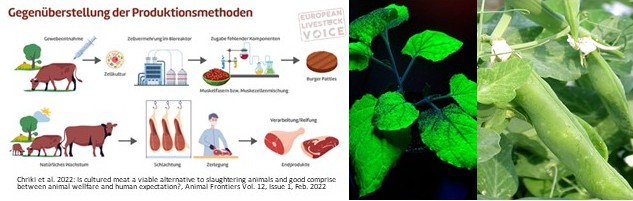
Animal cell culture systems for meat production have gained increasing attention in recent years, as they represent a promising alternative to conventional meat production from livestocks. This approach offers the potential for more sustainable production with reduced land, water, and energy consumption, lower greenhouse gas emissions, and improved animal welfare.
Animal cell culture relies on complex growth media that support cell proliferation and differentiation. These media are commonly supplemented with fetal bovine serum (FBS), which contains more than one hundred biologically active proteins at high concentrations. However, FBS has several disadvantages: it exhibits high batch-to-batch variability, may be contaminated with transmissible pathogens, and its collection raises ethical concerns. In regenerative medicine and pharmaceutical applications, animal cell culture systems are also of growing importance, leading to an increasing demand for serum-free cell culture media.
Plants can serve as efficient platforms for the production of recombinant proteins, similar to widely used bacterial or mammalian expression systems. Compared to established systems, plant-based production offers several advantages. Production platforms range from cell suspension cultures and transient expression systems to protein production in whole plants. Proteins can be targeted to specific tissues or cellular compartments. Depending on the system used, advantages may include very high expression levels, as observed in transient expression systems. Stable expression enables straightforward scalability and improved storage stability, particularly when proteins are produced in seeds. Importantly, all plant-based systems are free from animal or human pathogens.
Objectives
- Replacement of fetal bovine serum (FBS) in animal cell culture media
- Overexpression of selected protein candidates essential for cell proliferation and differentiation
- Evaluation of the most suitable plant-based production system
- Development of efficient and simple purification strategies
- Functional testing in animal cell culture systems
- Upscaling of the production platform
Results
Several proteins, including serum albumin, fetuin, basic fibroblast growth factor (bFGF/FGF2), and insulin-like growth factor 1 (IGF1), were transiently overexpressed in plants in different variants. For this purpose, the gene sequences of the porcine proteins were codon-optimized for plant expression, integrated into plant expression cassettes, and combined with appropriate signal sequences to ensure efficient expression, targeting, translation, and subsequent protein purification.
All four proteins were successfully produced using the transient plant expression system, in some cases at high expression levels. In addition, bFGF is produced through stable expression in pea seeds. Small-scale purification of all proteins has been established. Functional assays demonstrated that both bFGF and fetuin are biologically active and have already been successfully applied in animal cell culture systems.
Project Team
- MSc. Jennifer Dienel
- Dr. Parvaneh Ghasemian
- Dr. Jana Huckauf
Funding
Funded by Innocent Meat GmbH, January 1, 2025 – December 31, 2027.