
Breeding of quinoa for adaptation to temperate regions
Background
Quinoa (Chenopodium quinoa Willd.) is a traditional Andean crop that was domesticated approximately 5,000–7,000 years ago. In recent years, quinoa production and consumption have expanded rapidly worldwide due to its exceptional nutritional value and broad environmental adaptability. Despite its long history of cultivation, systematic breeding and genetic improvement programs have only been initiated in the past few decades. With the recent availability of high-quality genome sequences, genomic approaches can now be used to accelerate quinoa improvement and support its cultivation far beyond its region of origin.
Quinoa germplasm harbors extensive genetic diversity, providing valuable opportunities for crop improvement. The adaptation of quinoa to Northern European environments can strongly benefit from this diversity. Understanding the genetic basis of agronomically important traits is essential for the efficient development of improved varieties. In Central and Northern Europe, successful quinoa cultivation requires improved adaptation to long-day conditions as well as the enhancement of key agronomic traits, including plant performance and seed yield.
Objectives
- Identification of candidate genes for agronomically important traits by genome-wide association study (GWAS) and QTL mapping in quinoa
- Proteome and transcriptome analysis for identification of flowering time and photoperiod-response genes
- Identification of allelic variation affecting flowering time and other agronomically important traits in quinoa by haplotype analyses
- Identification of secondary metabolites differentially accumulated in response to downy mildew infection using metabolome analysis
- Selecting quinoa genotypes suitable for cultivation under northern European climate conditions
Results
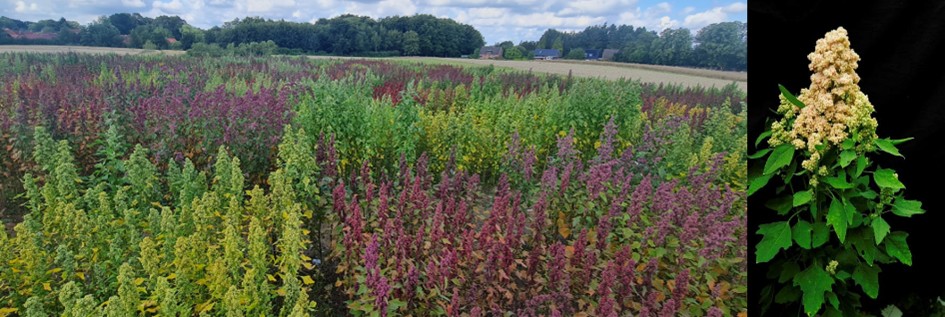
We conducted field trials with a diversity panel of 350 quinoa accessions, which showed substantial phenotypic variation in flowering time, protein content and other agronomically important traits. All accessions were whole-genome re-sequenced, resulting in approximately three million high-quality SNPs. Using genome-wide association analyses, we identified significant marker–trait associations for key traits such as flowering time, plant height, panicle length, saponin content, thousand kernel weight (TKW), and seed yield, and detected several candidate genes underlying these traits. These genomic resources allow the identification of promising parental lines for breeding quinoa varieties adapted to European conditions.
In parallel, we performed QTL mapping in a bi-parental population segregating for important agronomic and quality traits. Phenotyping of F₂ plants and their F₃ progenies over two years, combined with skim sequencing of the F₂ generation, revealed several QTL. Among them, two loci showed pleiotropic effects on flowering time, plant height, panicle length, and TKW, providing valuable markers for marker-assisted selection.
Building on these results, we have initiated a quinoa breeding program in Germany. Using the single seed descent (SSD) method, more than 200 segregating populations have been developed, with several populations already advanced to the F₆ and F₇ generations. Selected lines are currently being tested across multiple locations in Germany to identify high-performing cultivars suitable for temperate environments.
Project team
- MSc. Harshith Annaram
- Prof. Dr. Nazgol Emrani
Scientific Partners
- Prof. Dr. Karl Schmid, University of Hohenheim, Germany.
- Dr. Jochen Kumlehn, IPK, Gatersleben, Germany.
- Prof. Mark Tester, King Abdullah University of Science and Technology, Saudi Arabia.
- Dr. David Jarvis, Brigham Young University, Utah, USA.
- Prof. Dr. Sandra M. Schmöckel, University of Hohenheim, Germany.
- Dr. Kevin Murphy, Washington state university, USA.
Commercial Partners
- Saatzucht Streng-Engelen GmbH & Co. KG
- Lifespin GmbH
- Hans-Jürgen Steinmatz, Holstein Quinoa
Financial Support
- Bundesanstalt für Landwirtschaft und Ernährung (BLE), Project number: 281D117A21. Project duration: March 2023- May 2026.
- Validierungsfonds der Christian-Albrechts-Universität zu Kiel.
- Deutsche Forschungsgemeinschaft (DFG), Project number: EM 251/1-1.
- Stiftung Schleswig-Holsteinische Landschaft (Projekt Nr.2019/59).
- King Abdullah University of Science and Technology internal competitive research program (grant Nr. OSR-2016-CRG5-2966).