
Quinoa for future diversified agricultural systems
Background
Quinoa (Chenopodium quinoa Willd.) is a highly nutritious pseudo-cereal originating from the Andean region, known for its exceptional protein quality, broad abiotic stress tolerance (such as drought and salinity), and adaptability to marginal environments. In recent years, quinoa has gained much attention as an important crop for diversifying European agricultural systems. However, its successful large-scale cultivation in Central Europe is currently limited by insufficient adaptation to local climatic conditions and vulnerability to emerging pathogens.
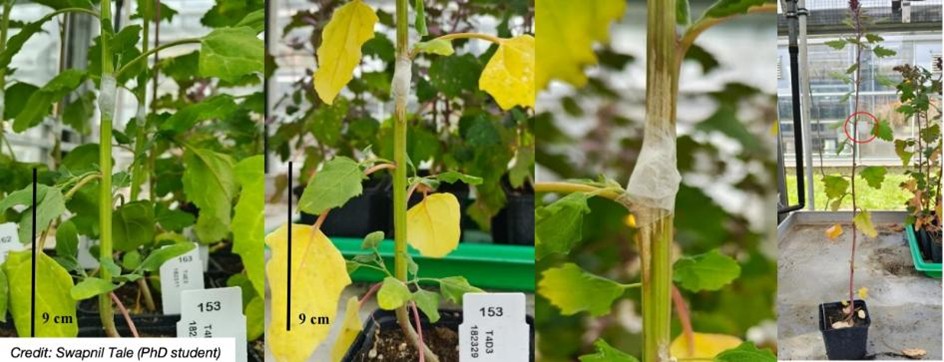
The Q4F project aims to accelerate the development of quinoa varieties adapted to European environments by combining genomic resources, quantitative genetics, and modern breeding mechanisms. A particular focus lies on improving resistance against biotic stresses, especially the fungal pathogen Sclerotinia sclerotiorum, which represents a growing threat for quinoa cultivation particularly in Germany.
The overarching goal of the project is to exploit the extensive genetic diversity available within quinoa to develop ideotypes that combine agronomic performance, yield stability, and durable stress resistance under Central European conditions.
Objectives
Quantify variation in resistance to Sclerotinia sclerotiorum across a genetically diverse quinoa panel under controlled conditions.
Identify genomic regions and candidate genes associated with disease resistance using genome-wide association approaches.
Analyze the genetic basis of traits such as flowering time, plant architecture, and yield components that contribute to adaptation and productivity.
Translate identified loci into molecular markers suitable for marker-assisted selection and genomic prediction.
Combine resistance and agronomic trait information to inform breeding mechanisms aimed at sustainable crop diversification.
Project team
- Dr. Abdul Saboor Khan
- MSc. Swapnil Tale
- Prof. Dr. Nazgol Emrani
Scientific Partners
- Prof. Dr. Remco Stam, Institute of Phytopathology - Dept. Phytopathology and Plant Protection, Kiel University, Kiel.
- Prof. Dr. Karl Schmid, Institute of Plant Breeding, Seed Science and Population Genetics (350), University of Hohenheim, Stuttgart.
- Dr. Til Feike, Institute for Strategies and Technology Assessment, Julius Kühn Institute, Kleinmachnow.
- Prof. Dr. Michael Rostás, Division of Agricultural Entomology, Department of Crop Sciences, Georg-August University Göttingen, Göttingen.
Financial Support
Funding for this research has been provided by the Federal Ministry of Research, Technology and Space (BMFTR), Project ID: 031B1546A-E. Project duration: May 2025-May 2029.