EQUATERRA: Healing the Land, Rebuilding the Future

EQUATERRA addresses the profound environmental and societal impacts of conflict by transforming the challenges of contaminated land, polluted water, and vast quantities of debris in Ukraine into opportunities for sustainable recovery. The project reframes these liabilities as resources for a green, circular, and community-driven reconstruction process, with the objective of developing and demonstrating a replicable blueprint for post-conflict recovery. It integrates the transformation of debris into bio-enhanced construction materials with the application of nature-based solutions to restore ecosystems, creating a synergistic cycle of rebuilding and environmental healing. Methodologically, EQUATERRA combines advanced technological approaches with strong community engagement through three Systemic Innovation Pilots (SIPs) in the domains of soil, water, and construction. Across these pilots, the project develops a portfolio of at least 31 bio-based solutions, with a minimum of 18 implemented in real-world settings. A Multi-Actor Approach ensures the active involvement and empowerment of local communities, supported by an AI-enhanced digital platform for mapping, analysis, and decision support. The project’s impact lies in delivering a robust, field-validated model for sustainable reconstruction, including the training of more than 200 stakeholders and the development of new business models. By fostering both technical capacity and social resilience, EQUATERRA provides the tools and collaborative frameworks necessary for communities to lead their own recovery, offering a scalable model applicable to Ukraine and other post-conflict regions worldwide.
An AI-Driven Approach for Minimally Disruptive Repairs of Reinforced Concrete Maritime Ports in Response to Climate Change

This PhD project develops an AI-driven framework for minimally disruptive repair and maintenance of reinforced concrete (RC) coastal infrastructure, with a particular focus on maritime ports under climate change. As chloride-induced corrosion, increasing environmental loads, and sea-level rise accelerate the deterioration of RC structures, there is an urgent need for sustainable, efficient, and resilient repair strategies. The research combines experimental investigations and advanced numerical modelling to assess innovative repair techniques using composite materials, such as sprayable polymers and textile-reinforced concretes, designed for rapid application with minimal operational interruption.
A key contribution is the development of AI-based surrogate models for predictive maintenance, enabling reliable lifetime assessment of repaired structures under evolving environmental conditions. These models integrate climate projections, material behaviour, and structural performance to support proactive decision-making. Furthermore, the project establishes a multi-criteria framework for evaluating repair strategies, considering durability, cost, environmental impact, and resilience. By linking experimental validation, high-fidelity simulations, and data-driven approaches, the project delivers robust tools for optimizing maintenance planning and extending the service life of coastal infrastructure. The project is co-supervised by Prof. Emilio Bastidas-Arteaga of La Rochelle University, strengthening its international and interdisciplinary scope.
NATURE-DEMO - Nature-Based Solutions for Climate-Resilient Infrastructure

NATURE-DEMO addresses the growing frequency and intensity of climate-related disruptions by strengthening the resilience of Europe’s infrastructure, which underpins economic activity, human well-being, and social stability. At the same time, it leverages this challenge as an opportunity to transform infrastructure through the integration of nature-based solutions (NbS). The project brings together infrastructure owners, industry and academic experts, and public authorities to develop, validate, and disseminate NbS for protecting critical sectors such as transport and energy. It promotes a shift from reactive risk management to the proactive design of systems that are resilient by design, structured around four core actions: Create, Validate, Scale, and Sustain. NATURE-DEMO develops an advanced digital decision-support platform that integrates climate projections, asset exposure data, NbS portfolios, and simulation tools to optimise implementation strategies and maximise co-benefits. Its methodology is validated through real-world demonstrations across five sites in the Alpine biogeographic region, with successful solutions subsequently replicated at additional sites across Europe. To ensure long-term impact, the project establishes tailored guidelines, a dedicated technical task force, and a financial observatory to support continued adoption and investment in NbS. Through this scalable, digitally enabled, and validated framework, NATURE-DEMO contributes to the EU’s vision of a climate-resilient and sustainable infrastructure system adapted to the demands of the 21st century.
HUBS4BUILD - Regional Circularity Hubs for a Bio-based and Resilient Built Environment

HUBS4BUILD aims to demonstrate, deploy, and scale systemic circular solutions across diverse European regions by establishing a network of permanent, replicable Circularity Hubs that integrate circular bioeconomy and construction value chains. The project co-designs and strategically develops these hubs in collaboration with over 500 local quadruple helix stakeholders to ensure context-specific and socially accepted solutions. It advances and validates a portfolio of more than nine bio-based construction products - such as insulation derived from textile waste and seagrass - alongside enabling governance models like Public-Private-People Partnerships. These solutions are implemented across 13 varied operational environments, where over 700 tonnes of local waste are valorised and more than 200 professionals are trained. To ensure long-term impact, the project develops a “Bankable Twinning Methodology” and fosters a “Replicators Network” to support large-scale adoption in collaboration with the CCRI and related initiatives. By combining material innovation with collaborative governance structures, HUBS4BUILD establishes new forms of cooperation among economic and societal actors, delivering a tangible and scalable model that contributes to the Circular Economy Action Plan and the EU Bioeconomy Strategy.
Basic Physical and Mechanical Behavior of Fastening Redundant Systems to Concrete Structures Using Direct Mounting Technology
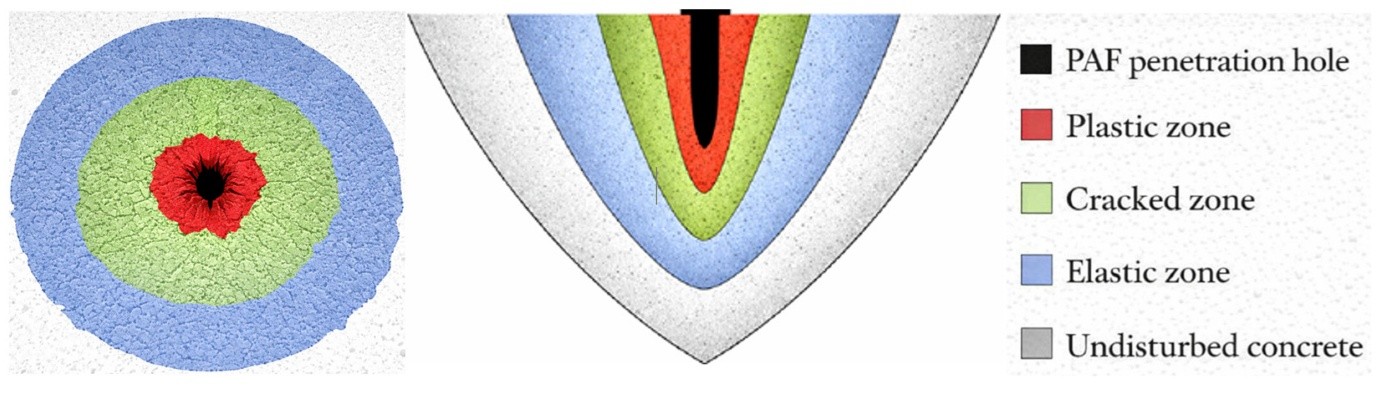
This project develops a probabilistic framework to analyse crack patterns in concrete slabs under seismic shear and flexural actions, with the aim of supporting the design and qualification of fastening systems. By combining algorithm-based modelling, statistical sampling, and numerical validation, the research predicts crack widths, spacing, and distributions, and evaluates their influence on predefined nail layouts. The outcomes provide a robust, evident-driven basis for understanding crack-induced effects in concrete structures and for improving engineering design methodologies.
Investigation of Anchors in Steel Fibre Reinforced Concrete under Dynamic Actions
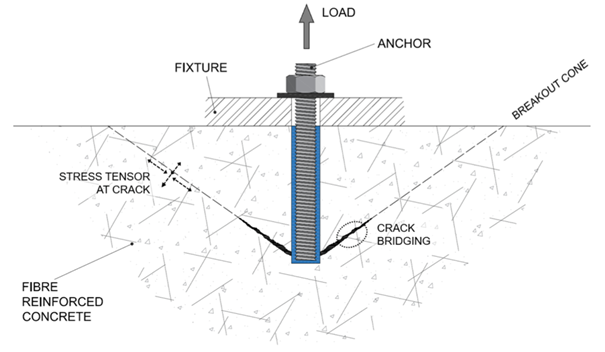
This research investigates the behaviour of fasteners in concrete, with a focus on the influence of steel fibre reinforcement under dynamic, fatigue, and seismic loading. It combines experimental testing and numerical modelling to improve the design of anchorage systems, in collaboration with Prof. G. Muciaccia (Politecnico di Milano), the EU Joint Research Centre in Ispra, and the Association Steel Fibre Technology.